

Your child just shared a toy without being asked for the first time. They spent ten full minutes intensely focused on building a lopsided, magnificent tower. These are the small, magical moments of growth that you witness every day.
But what if you could do more than just capture them in a photo? What if you could capture the story behind the moment? This is the power of using anecdotal records at home.
As a team of early childhood experts, we know this sounds like a professional tool—and it is! But it’s also one of the simplest and most powerful ways for you as a parent to see and understand your child’s development. This is especially true during the crucial preschool years, from ages 3 to 5, when growth happens in rapid, amazing bursts.
This guide is designed to demystify anecdotal recording. We will show you how this simple observation tool can help you see patterns in your child’s learning, celebrate their unique progress, and become an even more confident and informed expert on your own child. Forget complicated charts; this is about capturing the moments that matter.
What Are Anecdotal Records? (And Why They’re a Parent’s Superpower)
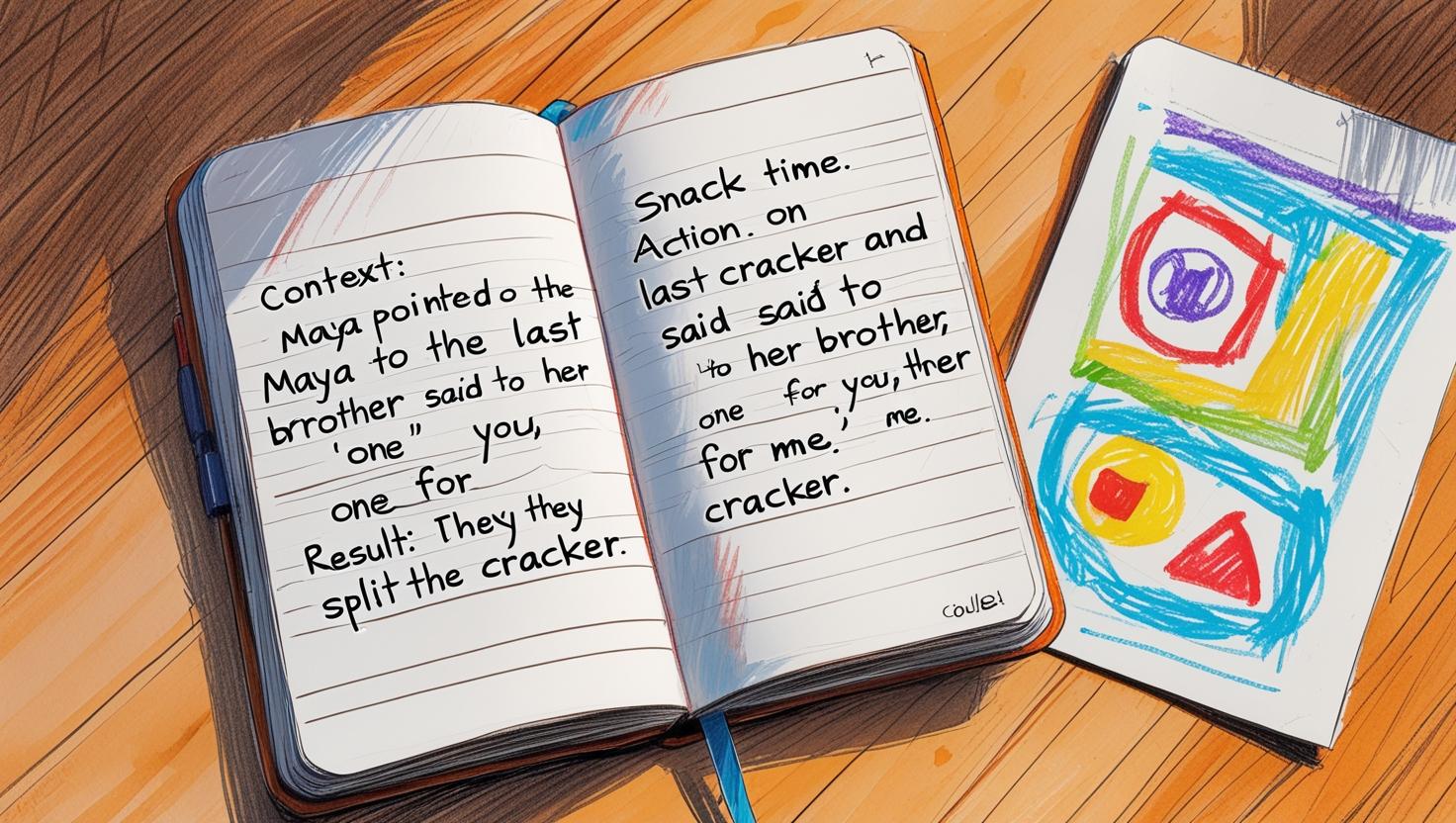
Let’s demystify the term right away. An anecdotal record is simply a brief, objective, written ‘snapshot’ of a specific event. Think of yourself as a sports commentator, describing exactly what happened, not as a judge evaluating the performance.
It’s a tool for capturing the ‘what, where, and when’ of a moment, not the ‘why’ or your personal feelings about it.
The power of this tool lies in its objectivity. It helps you separate what actually happened from your own interpretation. Here’s a classic anecdotal record definition in action:
- Interpretation (What we often do): “Leo was frustrated with his puzzle today.”
- Anecdotal Record (What we should do): “Leo tried to fit the circle piece into the square hole three times. He grunted and pushed the puzzle away with both hands.”
See the difference? The second example gives you pure data. It tells a much richer story about Leo’s problem-solving skills and frustration tolerance. By capturing these specific moments, you are gathering the evidence that shows you exactly which of the key stages of child development your child is working through, making you a more observant and effective guide on their journey.
The 60-Second Guide: How to Write a Powerful Anecdotal Note

This process should be fast and simple, not a chore. You don’t need a special notebook; the notes app on your phone or a stack of index cards works perfectly. The secret to a useful note is to capture three simple things: The Context, The Action, and The Result.
1. The Context (What was happening?)
Start with a quick, one-line setup. Where was the child and what was the general situation? This provides the ‘before’ picture.
- Example: “During outdoor play near the sandbox…”
- Example: “While we were reading a book on the couch…”
2. The Action (What did they DO and SAY?)
This is the heart of the note. Be a reporter. Use objective, action-focused language. Write down direct quotes if you can. This is the “what” you are observing.
- Example: “…Liam saw another child take his blue pail. He walked over, pointed, and said in a firm voice, ‘That’s my pail.'”
- Example: “…Maya pointed to the picture of the moon and said, ‘Look! That’s like the moon I saw in my window last night!'”
3. The Result (What happened immediately after?)
This is the quick conclusion. What was the immediate outcome of the action? This provides the ‘after’ picture.
- Example: “…The other child gave the pail back. Liam said ‘Thank you’ and continued digging.”
- Example: “…I asked her what shape it was, and she said ‘A circle! A white circle!’.”
Putting It All Together: An Anecdotal Record Sample
Here is a complete anecdotal record sample for preschool:
Date: 10/26/2025
Context: While building with LEGOs at the table…
Action: …Zoe tried to put a long green block on top of her tower, but it kept falling. She sighed, then took off two smaller blocks and placed the long green block on the bottom.
Result: …She then successfully stacked the two smaller blocks on top and said, “There! Now it’s strong.”
This 60-second note tells you a massive amount about Zoe’s resilience, problem-solving skills, and engineering thought process. That’s the power of this tool.
Your Tool to Make it Easy
While any piece of paper works, having a structured template can make your notes more organized and easier to review. To help you get started right away, our team has designed a professional, easy-to-use template.

You can download our: FREE Anecdotal Notes Template worksheet here.
It has all the right sections to guide your observations and help you capture the moments that matter.
From ‘Aha!’ Moments to Action: Using Your Notes to Support Your Child
Taking the notes is just the first step. The real magic happens when you take a few minutes at the end of the week to read through your observations. Laid out together, your short, objective notes will start to paint a rich and detailed picture of your child’s development. You’ll move from single data points to seeing clear patterns.
What to Look For in Your Notes
As you review, ask yourself these questions:
- What patterns do I see? “Wow, I notice he almost always chooses to play with the LEGOs. He’s really interested in building.”
- What are their emerging skills? “She is starting to recognize the first letter of her name on signs. That’s a new skill this month.”
- Where are they showing persistence? “He got really frustrated with that puzzle, but he came back to it three times. His frustration tolerance is growing.”
- What are their social tendencies? “I see she often plays alongside other kids, but rarely initiates conversation. Maybe we can work on that.”
Turning Observations into Action
These ‘aha!’ moments from your notes are your personalized roadmap for supporting your child. They allow you to move beyond generic advice and provide truly targeted support.
- Fuel Their Interests: If your notes show a deep love for building, you can use that passion to introduce new concepts. You can use those observations to create targeted lesson plans at home if you’re homeschooling, like counting blocks or measuring towers.
- Support Their Next Step: If you see they’ve mastered recognizing the letter ‘A’, you can use that insight to inform your goal-setting process. The next goal might be to introduce the next letter in their name.
- Share Specifics with Teachers: Instead of saying “How is she doing socially?”, you can say, “I’ve noticed at home she’s great at sharing but hesitant to start conversations. Are you seeing that in the classroom too?” This leads to a much more productive partnership.
The Do’s and Don’ts of Anecdotal Records: Best Practices for Parents
Using this tool effectively and responsibly is just as important as knowing how to write the notes. As you adopt this practice, keeping these professional ‘best practices’ in mind will ensure your observations are both useful and respectful of your child’s journey.
The Advantages: What You Gain
- Authentic Assessment: Unlike a test, these notes capture your child’s skills in a natural, real-world setting.
- Individualized Insight: You get a detailed picture of your child’s unique strengths, interests, and challenges, free from comparison to others.
- Focus on Positives: The process naturally trains you to look for moments of growth and success, not just problems.
The Disadvantages (and How to Avoid Them)
- Potential for Bias: It’s easy to only record moments that confirm what you already believe. The Fix: Make a conscious effort to record a variety of situations—happy, frustrating, social, and solitary moments.
- Time-Consuming: It can feel like ‘one more thing to do’. The Fix: Don’t try to record everything. Aim for just 3-5 high-quality notes per week. Consistency is more important than quantity.
- Risk of Misinterpretation: A single note out of context can be misleading. The Fix: Always look for patterns over time. Never draw a major conclusion from a single observation.
The Golden Rules of Ethical Observation
- Be Objective, Not Judgmental: Record what you see, not what you think it means. Stick to the facts.
- Ensure Privacy: These notes are about your child’s development. Keep them private and share them only with trusted partners in your child’s education, like their other parent or their teacher.
- Focus on the Child, Not the Task: The goal isn’t to see if they completed the puzzle. The goal is to observe how they approached the puzzle. The process is always more important than the product.
10 F.A.Q. About Anecdotal Records Answered
Adopting a new tool can bring up a lot of questions. Here are our expert answers to the most common queries we get from parents about using anecdotal notes at home.
How often should I be writing these notes? I'm worried it's too much work.
The goal is consistency, not quantity. Dont try to document everything! A great starting point is to aim for just 3 to 5 high-quality notes per week. Capturing a few meaningful moments consistently is far more valuable than trying to write things down every single day and getting burnt out. Keep it simple and manageable.
Is it okay to record 'negative' behaviors?
Yes, absolutely. The key is to remain objective. Instead of writing 'Leo had a terrible tantrum', an anecdotal note would say, 'When asked to turn off the TV, Leo threw himself on the floor and cried for three minutes'. This is not a judgment; it is valuable data that can help you identify triggers and patterns for challenging moments.
What's the difference between an anecdotal record and just keeping a journal?
This is a crucial distinction. A journal is typically subjective and filled with your emotions and interpretations ('I was so proud today when...'). An anecdotal record is objective and factual. It records only what you saw and heard. It is the 'evidence' you can later use to reflect on, whereas a journal is the reflection itself.
Should I tell my child that I'm writing things down about them?
For young children, transparency is usually the best policy. You can frame it in a positive and simple way. If they ask, you can say, 'I am just writing down all the amazing things you are learning and doing each day so we dont forget!' This models that their actions and progress are important and worth noting.
What do I do if I don't see any 'big moments' to record?
This is a common worry, but the 'small moments' are often the most insightful! A 'big moment' like their first time riding a bike is great, but a small moment, like noticing they spent five minutes trying to figure out how a zipper works, tells you much more about their persistence and fine motor skills. The goal is to capture the process, not just the performance.
Can I use video or photos instead of writing?
Photos and videos are wonderful for capturing memories, but the act of writing an anecdotal note serves a different purpose. Writing forces you to be selective and objective about what you are seeing. A great compromise is to take a photo of a moment and then add a short, 2-3 sentence anecdotal note to it in your phone. This gives you the best of both worlds.
How should I share these notes with my child's teacher without seeming like a 'helicopter parent'?
The key is to frame it as a partnership. At your next parent-teacher conference, you can say, 'I have been keeping some simple notes at home, and I noticed a pattern in how much she loves to build. Are you seeing that same interest here?'. This shows you are an engaged observer and offers valuable insight, rather than telling the teacher what to do.
What is a 'running record' and how is it different from an anecdotal record?
A 'running record' is a much more intensive observation tool used by educators. It involves writing down nearly everything a child says and does in a specific block of time (e.g., 10 straight minutes). An anecdotal record, on the other hand, is just a quick 'snapshot' of a single, specific moment. For parents, anecdotal records are a much more practical and manageable tool.
Become the Expert on Your Own Child
You don’t need a degree in child development to understand your child’s unique journey. Tools like anecdotal records are not meant to turn your home into a classroom, but to empower you with a new way of seeing. They allow you to move past generic milestone charts and tune into the real, nuanced story of your child’s growth, one small moment at a time.
By capturing these objective snapshots, you’re doing more than just documenting; you’re becoming a detective of your child’s development. You’re learning to see the world through their eyes, celebrate their unique process, and identify exactly where they might need a little extra support. This practice of mindful observation is one of the greatest gifts you can give your child.
And when your observations reveal an area where your child is ready for a new challenge or needs a bit more practice, having the right tools at your fingertips is key. To help you act on your insights, our complete bundle of educational worksheets provides hundreds of fun, targeted activities to support every stage of their preschool learning adventure.