
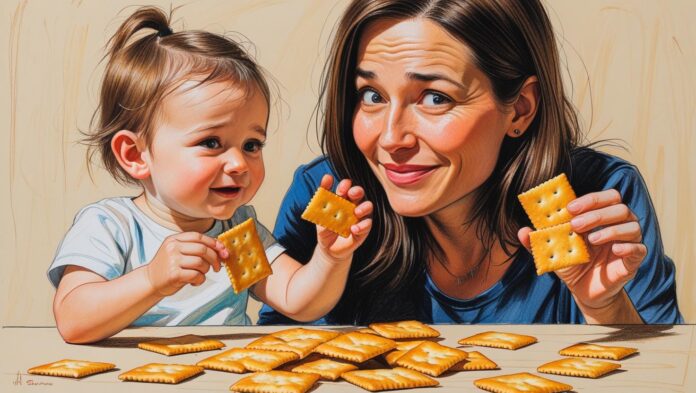
Your preschooler (ages 3-4) can proudly count to 20, a feat you’ve celebrated and recorded. But when you ask them to please get five crackers from the box, they return with a happy, random handful. What’s happening?
As a team of early childhood experts, we can tell you: you’ve just witnessed the crucial difference between reciting numbers like a song (rote counting) and true mathematical understanding—a key developmental leap in the preschool years.
The bridge between these two worlds, and the secret skill that unlocks real number sense, is a foundational concept called one-to-one correspondence. It sounds academic, but it’s a simple, vital idea that is the absolute bedrock of all future math, from counting and addition to algebra.
This guide is designed to make you an expert on this crucial pre-math skill. We will simply explain what one-to-one correspondence is, why it’s so important for kids ages 3, 4, and 5, and give you a toolkit of incredibly fun, play-based games—like the ‘Parking Lot Game’ you may have seen online—to teach it at home without any stress or frustration.
From Rote Counting to Real Understanding: A Simple Definition

To truly grasp what is one-to-one correspondence, it’s easiest to first understand what it isn’t. You’ve already seen the first step of learning to count in action: rote counting.
What is Rote Counting?
Rote counting is the ability to recite numbers in the correct order from memory. It’s like singing the ABC song. Your child knows the sequence “one, two, three, four, five,” but they haven’t yet connected those words to actual quantities. They have the ‘music’ of counting, but not the ‘meaning’. This is a vital first step, but it’s not true counting.
What is One-to-One Correspondence?
This is the magical next step where true understanding begins. One-to-one correspondence is the skill of matching one, and only one, number word to each object in a set as it is being counted. It’s the physical act of:
- Touching the first block and saying “one.”
- Touching the second block and saying “two.”
- Touching the third block and saying “three.”
A child who has mastered this skill understands that the number is tied to the object. It’s the crucial difference between knowing the symbols and words (like recognizing the numbers 1-10) and understanding what those numbers actually represent in the real world. This is the foundation upon which all future, more complex one-to-one correspondence math is built.
5 Fun, Everyday Activities to Build One-to-One Correspondence

The best way to teach this skill is to weave it into your daily life. You don’t need fancy flashcards or complicated games. These simple, hands-on one-to-one correspondence activities turn everyday routines into powerful learning moments.
1. The Snack Count
Snack time is a perfect, low-pressure moment for counting. Line up a few crackers, berries, or goldfish on the table. Slowly touch each one as you count it aloud together: “One… two… three…” This makes the concept of counting tangible and delicious.
2. The Tidy-Up Count
Turn clean-up time into a counting game. Instead of saying “Put your cars away,” try “Let’s put five red cars into the bin. Let’s count them as they go in!” This gives a concrete number goal and makes a chore feel like a mission.
3. The Dinner Table Setup
This is a classic for a reason. Ask your child to help set the table. Say, “We need three forks for the three plates. Can you put one fork next to each plate?” This is a real-world application of matching one object to another that feels very grown-up and important to a child.
4. The Stair Count
Every time you go up or down the stairs, make it a habit to count each step as your feet touch it. This physical, rhythmic counting is fantastic for reinforcing the one-to-one principle. You can even vary your voice, counting in a whisper or a silly giant voice.
5. The Laundry Sort
Sorting laundry is full of counting opportunities. “Let’s find all the socks! How many do we have? Let’s count them.” Or, “Can you hand me four t-shirts?” These simple questions naturally encourage one-to-one counting. For even more inspiration, you can find a huge list of other fun math activities for preschoolers that build this and other core skills.
Level Up: Creative Games & Targeted Worksheet Practice

Once your child is comfortable with counting objects in your daily routines, you can introduce some fun, structured games to master the skill. After these hands-on games, a targeted one-to-one correspondence worksheet can be a great way to transfer that knowledge to paper.
The ‘Parking Lot’ Game
This is a viral favorite for a reason—it’s incredibly effective and fun! Here’s how to set it up:
- Label Your Cars: Take a few toy cars and tape a small piece of paper with a number (1-10) on top of each one.
- Create the Parking Lot: On a large piece of paper or cardboard, draw several “parking spots.” In each spot, draw a different number of dots (e.g., three dots in one spot, five in another).
- Play! The mission is for your child to count the dots in a parking spot and then find the car with the matching number to park it there. This is a fantastic game for both counting and number recognition.
The ‘Jumping’ Game
This simple game adds an element of excitement and competition.
- Set Up the Race: Draw a ‘START’ line and a ‘FINISH’ line on a piece of paper. Place two small toys (like animal figures) at the start.
- Roll and Jump: Take turns rolling a single die. The child counts the dots on the die and then “jumps” their toy that many spaces forward. The first toy to the finish line wins!
Reinforcing with Targeted Worksheets
After your child has physically manipulated objects, worksheets can help solidify their understanding in a 2D format. The key is to find worksheets that are clear and engaging. To get you started, you can download our fun animal counting worksheets. They are perfectly designed to help a child count the objects and then circle the correct number, directly reinforcing one-to-one correspondence.
10 F.A.Q. About One-to-One Correspondence Answered
Understanding this foundational math skill can bring up some specific questions. Here are our expert answers to the most common queries from parents.
What is the meaning of one-to-one correspondence in simple terms?
In the simplest terms, it means matching one number word to one object as you count. Think of it as 'one touch, one number'. A child who has this skill knows that the word 'three' corresponds to the third object they touch, and not just a word in a memorized song.
Can you give a real-life example of one-to-one correspondence?
Absolutely! A perfect real-life example is setting the dinner table. When your child puts one napkin next to each plate, they are performing a one-to-one correspondence task. They are matching one object (a napkin) to another object (a plate) in a set. This shows they understand the concept in a practical, real-world context.
How do you best explain one-to-one correspondence to a child?
You dont explain it with words; you show it with actions. The best way is to model it yourself. When counting their toys, physically touch each toy and slightly push it forward as you say the number. Say, 'Watch me count my fingers. One...' (touch your thumb), 'Two...' (touch your index finger). Your physical actions make the abstract concept concrete and clear for them.
At what age should my child master this skill?
Children typically master one-to-one correspondence between the ages of 3 and 5. A 3-year-old is just beginning to grasp it, while a 4 or 5-year-old should be able to consistently count a group of up to 10 objects with accuracy. It is a key readiness skill for kindergarten.
What's the next math skill to learn after this?
The next step is often a concept called 'cardinality'. This is the understanding that the last number you say when counting a group of objects represents the total amount in that group. After you count five blocks, you can ask, 'So, how many blocks are there?' A child with cardinality will confidently say 'Five!'. This is the skill that leads directly to addition.
Is there one-to-one correspondence in writing?
Yes, but it is a slightly different concept. In early reading and writing, it refers to a childs ability to match one spoken word to one written word on a page as they 'read'. While it shares a name, the term is most commonly and critically used in the context of pre-math and counting skills.
My child can count to 50 but can't count 5 objects. Is this normal?
Yes, this is completely normal and it perfectly illustrates the difference between rote counting (memorizing the number song) and one-to-one correspondence (understanding the meaning). Their ability to count to 50 is a great sign of a good memory, but now is the perfect time to use the playful activities in this guide to help them connect those number words to actual objects.
The Foundation of All Future Math: A Final Word
It may seem like a small step, but the journey from reciting numbers to truly understanding them through one-to-one correspondence is one of the most significant leaps in your child’s education. This single skill transforms numbers from a memorized song into a powerful tool for understanding the world. You are not just teaching them to count objects; you are laying the essential groundwork for addition, subtraction, and all the complex math that lies ahead.
Remember to keep it fun, weave it into your daily life, and celebrate their progress. By being a patient and playful guide, you are building more than just a math skill—you are nurturing a confident, curious problem-solver who isn’t afraid to engage with numbers.
As your child masters counting and is ready for the next challenge, our team has designed the perfect toolkit to grow with them. To support their entire early math journey, from counting and number recognition to shapes and simple addition, explore our complete math worksheet bundle. It’s packed with hundreds of activities to turn these foundational skills into a lifelong love of math.