
As a team of early childhood experts who work with parents every day, we know the immense pressure you face preparing a child for kindergarten. You’re surrounded by checklists of academic skills, drilling the alphabet and counting, all while wondering if your child is keeping up. This focus is understandable, but our collective experience and research show it’s often aimed at the wrong target.
Here’s a fact that we often share with parents to help reframe their perspective: extensive research on early childhood development has shown that a child’s social-emotional skills are the most significant predictors of future success, both in school and in life.
One landmark study even found these skills to be ten times more predictive than academics or demographics alone. This isn’t just a comforting thought; it’s a data-backed directive for where to focus your energy.
This is the most crucial piece of kindergarten teacher advice we can offer. It’s what what kindergarten teachers want parents to know most: we are not looking for children who have memorized the most facts.
We are looking for resilient, curious, and emotionally capable children who are truly ready to learn. In this guide, our team will walk you through the five core skills that build this essential foundation.
Core Skill n.1: Building Emotional Endurance & Resilience

Picture this common scene: a five-year-old meticulously builds a magnificent tower of blocks. It wobbles, it crashes. The reaction is immediate and total: a full-blown meltdown. In that moment, all learning stops.
Now, picture another child. Their tower also crashes. They let out a frustrated sigh, look at the pile of blocks, and start again, maybe with a different strategy. That second child possesses the single most valuable asset in a kindergarten classroom: emotional endurance.
This isn’t about being ‘tough’ or suppressing feelings. It’s the ability to experience a setback, feel the resulting frustration, and move through that emotion without shutting down. In a classroom of 20+ children, small frustrations happen constantly—a crayon breaks, a friend doesn’t want to play, a puzzle piece won’t fit.
A child who spends 10 minutes recovering from each minor setback misses a significant amount of instruction and social interaction. A child with emotional endurance is a child who is consistently available and ready to learn.
How to Coach Resilience at Home (The 3-Step Method)
When your child is frustrated, your instinct might be to fix the problem or say, ‘Don’t cry, it’s okay!’ We recommend a more powerful, three-step coaching method:
- Narrate & Validate: Get down on their level and calmly state the facts and the feeling. “You worked so hard on that, and it all fell down. That is so frustrating. It’s okay to feel angry about that.” This step tells them their feelings are seen, understood, and acceptable.
- Allow a Moment: Don’t rush to solve it. Give them 30 seconds to simply feel the emotion. This small pause teaches them that feelings are temporary and manageable, not emergencies that need to be instantly erased.
- Shift to Problem-Solving: After the moment has passed, shift the focus forward. Ask a low-pressure, collaborative question: “That was a tough one. When you’re ready, what do you think we could try next? Should we make a wider base?” This moves them from feeling like a victim of the problem to an actor in the solution.
A crucial foundation for this process is helping children understand what they’re feeling in the first place. You can’t manage an emotion you can’t name. Actively building their emotional vocabulary with tools and games is one of the most direct ways to support this core skill.
Core Skill n.2: Mastering Multi-Step Directions

In a bustling kindergarten classroom, instructions are the currency of the realm. A teacher might say, “Please put your drawing in the red folder, and then place the folder in your cubby.”
This seems simple, but for a five-year-old, it’s a complex cognitive task that relies heavily on working memory—the brain’s ‘sticky note’ for holding onto information temporarily. A child who can reliably follow two-step directions is a child who stays in the flow of the classroom, feeling capable and aware.
A child whose working memory gets overloaded by step two is constantly playing catch-up, which can lead to feelings of confusion and anxiety.
The ability to follow multi-step directions is not about obedience; it’s about reducing a child’s cognitive load so they can focus on the actual learning task. This is one of the most impactful skills you can practice at home, and it doesn’t require any special materials.
How to Build Working Memory in Everyday Life
Turn your daily routines into fun, brain-building games. The key is to start with one instruction and, once that’s mastered, add a second component. We call this the ‘First-Then’ game.
- During Tidy-Up Time: Instead of a vague “clean your room,” give a specific ‘First-Then’ command. “First, put the blue cars in the bin, then put the books on the shelf.”
- When Getting Ready: “First, put on your socks, then bring me your shoes.” This breaks down a larger task into manageable chunks.
- In the Kitchen: This is a goldmine for practicing. “First, get the plastic bowl, then get the wooden spoon.” “First, throw this wrapper in the trash, then wash your hands.”
Start simple and celebrate every success. As they get better, you can occasionally try a three-step direction to gently stretch their abilities. You are not just teaching them to listen; you are actively strengthening the neural pathways that support focus and executive function.
Core Skill n.3: The Courage to Be a Beginner

In both preschool and kindergarten, every single day is filled with new experiences: new social rules, new materials, and new academic challenges. For many children, this novelty is exciting. But for some, the fear of not being good at something immediately can be paralyzing.
They might refuse to try, saying “I can’t do it” before they even pick up the crayon. This isn’t defiance; it’s a fear of incompetence. The courage to be a beginner—to try something new without any guarantee of success—is a skill that unlocks the entire early learning curriculum, from age 3 to 7.
Teachers see this all the time. A child who is a fantastic storyteller might refuse to draw because they feel their art doesn’t look ‘right’. A child who loves to build might avoid writing activities because forming letters feels awkward.
As experts, we know that learning isn’t a performance; it’s a process. Our goal is to encourage effort and celebrate the ‘having a go’ over the final product, whether they are 4 or 6 years old.
How to Nurture a ‘Growth Mindset’ at Home
The language you use at home has a profound impact on your child’s willingness to be a beginner. The key is to shift your praise from results to process.
- Praise the Effort, Not the Outcome: Instead of “That’s a beautiful drawing!” (which focuses on the result), try “I saw how you focused so hard on choosing your colors. You really worked on that.”
- Praise the Strategy, Not the Trait: Instead of “You’re so smart!” (which implies a fixed trait), try “Wow, you tried a few different ways to make that puzzle piece fit. That was great problem-solving.”
- Model Being a Beginner Yourself: Let your child see you try something new and struggle. Say out loud, “I’ve never cooked this before, so I’m not sure how it will turn out, but it’s fun to try!” This normalizes the process of learning and shows that it’s okay not to be perfect.
One of the first places this ‘fear of being a beginner’ shows up is with handwriting. The physical act of holding a pencil can feel unnatural.
Instead of focusing on perfect letters, you can support the very first step of the process. Understanding the mechanics of a proper handwriting pencil grasp can give you the tools to help your child feel more comfortable and confident from the start, making them more willing to try.
Core Skill n.4: The Capacity for Independent Play
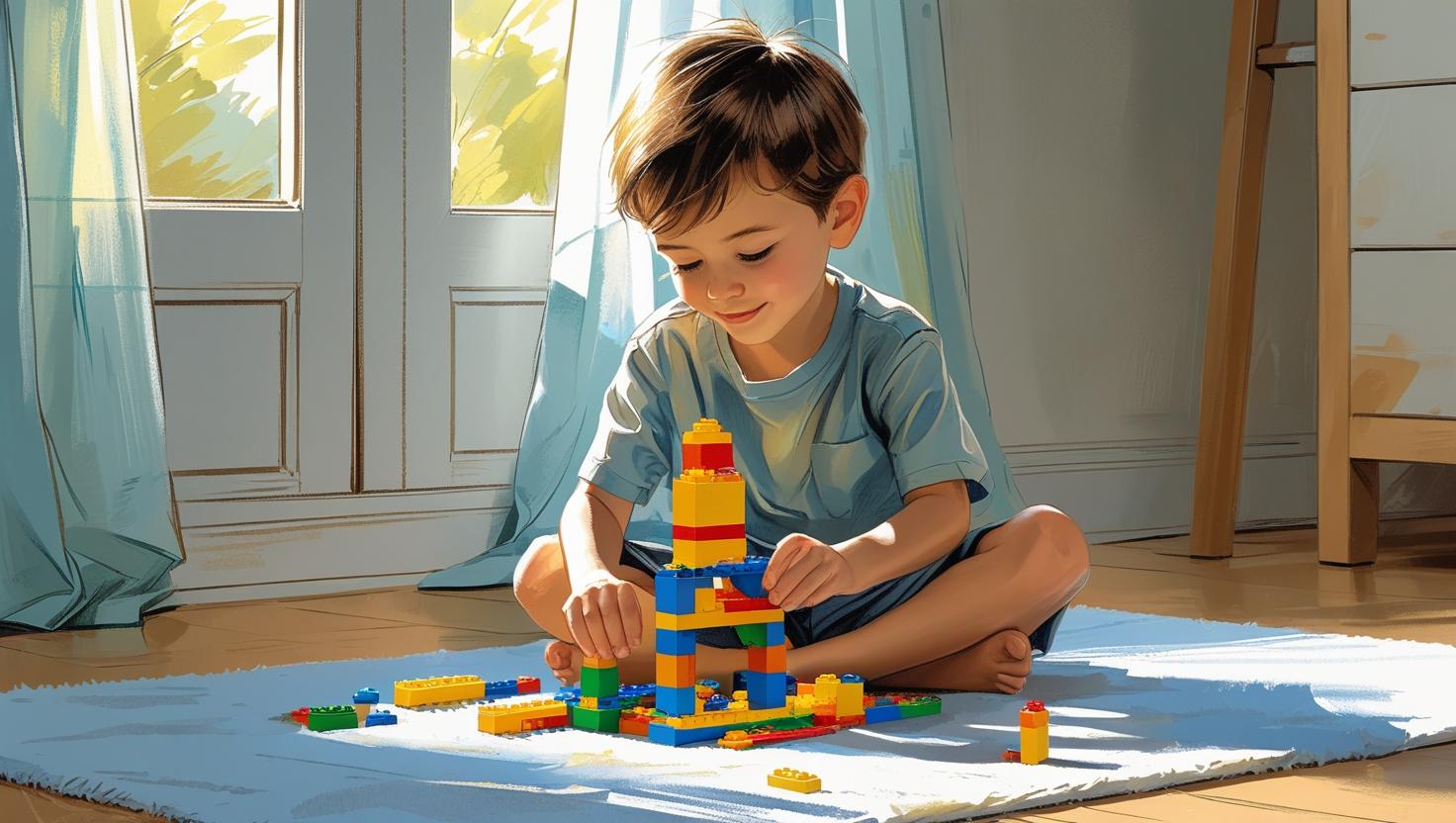
In a classroom environment, teachers cannot provide one-on-one engagement every minute of the day. They work with small groups, assess individual students, and manage classroom logistics.
During these times, a child’s ability to engage in purposeful, independent play is not just ‘keeping busy’—it’s a sign of a critical cognitive skill: self-direction. This skill looks different across the early years, but its importance is constant.
A child who can happily immerse themselves in a task—be it building, drawing, or working on a puzzle—is actively developing focus, creativity, and problem-solving skills.
Conversely, a child who constantly needs adult direction (‘What do I do now?’) can struggle to initiate tasks and may miss out on valuable peer interactions. Fostering this independence at home is one of the greatest gifts you can give both your child and their future teacher.
What Independent Play Looks Like (Ages 3-7)
Your expectations for independent play should grow with your child. Here are some realistic benchmarks:
- For a Preschooler (Ages 3-4): The goal is short, focused bursts. Aim for 10-15 minutes of independent engagement. This might look like working with a single set of materials, like Play-Doh, a simple puzzle, or a bin of animal figures.
- For a Kindergartener (Ages 5-7): The duration can stretch to 20-30 minutes. The play itself might become more complex, involving a narrative (e.g., their LEGO figures are having an adventure) or a clear goal (e.g., completing a multi-step art project).
How to Build the ‘Independent Play’ Muscle
This skill can be coached. The strategy is called ‘scaffolding’. You provide initial support and then gradually step back.
- Connect and Initiate: Start by playing with your child for 5-10 minutes. Get them deeply engaged in the activity. Ask questions, help them set up a story or a goal.
- Give a ‘Mission’ and Retreat: Once they are engaged, give them a small, specific ‘mission’. Say, “I have to go check on the laundry. While I’m gone, can you build a garage for this blue car?” This gives them a clear, short-term objective.
- Return and Praise: After a few minutes, return and praise their independent effort. “Wow, you built that all by yourself while I was gone! Tell me about it.” This reinforces that their independent work has value.
Providing simple, engaging activities with clear rules is key. For example, a task like matching uppercase and lowercase letters is a perfect independent activity once the concept has been explained. It has a clear goal and allows a child to feel a sense of accomplishment on their own.
Core Skill n.5: The Power of Clear Communication

The ability of a child to express their needs, wants, and ideas using words is perhaps the most fundamental skill for school success. Clear communication is the tool they use to ask for help, resolve conflicts with friends, share their brilliant ideas, and connect with their teachers.
When a child can’t find the words to express a big feeling or a complex thought, it often leads to frustration, which can manifest as withdrawal or disruptive behavior. As experts, we’ve seen countless classroom situations de-escalated simply because a child could say, “I’m feeling crowded,” or “Can I have that when you’re done?”
Nurturing this skill at home doesn’t mean correcting grammar or pushing for a huge vocabulary. It means creating an environment where language is a tool for connection, not just for requests.
How Communication Skills Evolve (Ages 3-7)
The journey from a preschooler’s simple sentences to a first-grader’s detailed stories is remarkable. Here’s what teachers look for:
- For a Preschooler (Ages 3-4): The focus is on clarity and needs. Can they speak in sentences of 3-4 words? Can they answer simple ‘who’, ‘what’, and ‘where’ questions? Can they express their basic needs (e.g., “I’m hungry,” “I need to go potty”)?
- For a Kindergartener (Ages 5-7): Language becomes a tool for storytelling and detail. Can they tell you about something that happened earlier in the day, in the correct sequence? Can they use more complex sentences and ask ‘why’ and ‘how’ questions?
How to Be Your Child’s ‘Language Coach’
You are your child’s most important conversation partner. Here are some powerful, yet simple, coaching techniques:
- Expand on Their Reality (Recasting): When your child says, “Dog run,” you expand on it: “Yes, the big brown dog is running so fast!” This models richer sentence structure without directly correcting them.
- Wonder Out Loud: This is a powerful way to encourage curiosity and complex thinking. During a walk, say, “I wonder why all the leaves are turning brown,” or at the store, “I wonder how they get all the cereal into these boxes.” This invites conversation and shows them how to think with language.
- Prioritize the ‘Dinnertime Download’: Make it a daily ritual to go around the dinner table and have each person share one good thing and one ‘tough thing’ about their day. This teaches children the rhythm of conversational turn-taking and gives them a safe space to practice storytelling.
Supporting this at home can also involve structured activities. Understanding how well-designed materials can help learning gives you a framework for using them not as drills, but as conversation starters to build vocabulary and concepts together.
The ‘Ready’ Child Is a Resilient Child

The journey to kindergarten can feel like a high-stakes performance, with academic milestones serving as the script. But as we’ve explored, the skills that truly matter are not written on a report card.
They are written in a child’s character. The secret that seasoned teachers and developmental experts want you to know is this: we are not looking for the most knowledgeable child, but the most teachable one.
A teachable child is one who possesses emotional endurance, who can follow directions, who has the courage to be a beginner, the capacity for independent focus, and the ability to communicate their needs.
These five core skills are the bedrock of a successful and, more importantly, a happy student. They are the tools that allow a child to navigate the wonderful, messy, and exciting world of school with confidence.
So, take the pressure off yourself and your child. Shift your focus from drilling splinter skills to nurturing these deep, resilient roots at home. Celebrate their effort, coach them through frustration, and model the joy of learning. You are not just preparing your child for the first day of school; you are preparing them for a lifetime of learning.
What Teachers Wish Parents Knew: 10 F.A.Q.
We gathered the most common, real-world questions that parents ask kindergarten teachers. Here are our honest answers.
What do kindergarten teachers wish parents would STOP doing?
Honestly? We wish parents would stop asking us 'Is my child the best?' or 'Are they ahead of the others?' upon meeting us. This sends a message that you value performance over development. Instead, ask 'What can I do at home to best support your classroom goals?' or 'What are my child's unique strengths and how can we build on them?' This frames us as a team with a shared goal: your child's well-being.
Is it normal for my child to cry on the first day of kindergarten?
Yes, it is 100% normal. Tears are a healthy expression of a big emotion about a major life change. The best thing you can do is create a quick, confident, and loving goodbye. Say 'I love you, I will be back to get you, you are going to have a great day', give a hug, and then leave without lingering. A prolonged, anxious goodbye is often more for the parent than the child and can make the separation harder. We are experts at comforting and redirecting children after you leave.
How much homework should a kindergartener have?
Very little, if any. The consensus among early childhood experts is that formal homework for a five-year-old is not developmentally appropriate. The most you should expect is a folder with papers to review, or perhaps a nightly expectation of reading a book together for 15-20 minutes. The real 'homework' for this age is play, family dinner conversations, and a good night's sleep.
I feel pressured to teach my child to read before kindergarten. Should I?
No. Please release yourself from that pressure. Pushing a child to read before they are developmentally ready can backfire, creating anxiety and a negative association with books. Your job is not to be a reading instructor; it's to be a 'reading cheerleader'. Foster a love for stories, make the library a magical place, and let them see you enjoy reading. We will handle the phonics and formal instruction.
What is the best way to communicate with my child's teacher?
Be proactive and respectful of their time. The best method is usually a short email to schedule a quick phone call if you have a concern that requires discussion. For quick notes, a message in a designated communication app or a note in their folder works well. Avoid trying to have a serious conversation during the chaos of morning drop-off or afternoon pick-up, as our attention is focused on the safety of all the children.
What are the TOP 3 social skills my child really needs?
If we had to choose only three, they would be:
1. The ability to lose a game without a meltdown.
2. The ability to join a group of peers who are already playing.
3. The ability to ask a peer or teacher for help using words. A child who has these three skills is socially and emotionally ready for almost any challenge our classroom can throw at them.
My child is very shy and anxious about school. What can I do?
Focus on demystifying the experience. Read books about starting kindergarten. Visit the school playground on a weekend so it feels familiar. Role-play specific scenarios at home, like 'What do you do if you need to go to the bathroom?' or 'How do you ask someone their name?' If possible, find out if one other child from their preschool is in their class and arrange a playdate beforehand. A familiar face can make all the difference.
What does 'play-based learning' actually mean? Are they just playing all day?
This is a fantastic question. 'Play-based learning' does not mean unstructured chaos. It means we have designed the classroom and activities so that children learn essential academic and social concepts through play. When they are in the 'block center', they are learning physics and negotiation. In the 'dramatic play' kitchen, they are learning literacy, sequencing, and cooperation. It is highly intentional, purposeful play designed by educators to meet learning objectives.
How important are sight words in the first few months?
They are important, but they are our job to teach. Your child is not behind if they don't know any sight words on day one. We will introduce them systematically. The best thing you can do at home is simply point out words in the environment—on street signs, cereal boxes, or in books. This builds the general concept that those little squiggles on a page have meaning, which is the foundation for all reading.
What is the one thing I can do at home that makes the biggest difference?
Protect their sleep. It's that simple. A well-rested five-year-old is a happy, regulated, and engaged learner. A tired five-year-old struggles with emotional endurance, focus, and frustration tolerance. The American Academy of Pediatrics recommends 10-13 hours of sleep per 24 hours for children ages 3-5. Consistently honoring an early bedtime is more impactful than any academic drill you can do.