

Your child is bright, creative, and can tell you an elaborate story about dinosaurs. But when they sit down to write, something happens that can make a parent’s heart skip a beat: the letters come out backward.
You see a ‘d’ where a ‘b’ should be, a ‘p’ instead of a ‘q’, or even numbers like ‘3’ and ‘7’ facing the wrong way. This is the classic challenge of reversing letters.
If you’re worried, let’s start with a fact from developmental experts: for children between the ages of 3 and 7, letter reversals are not just common; they are a developmentally appropriate and expected part of learning to write.
It is not an early sign of a learning disability in most preschool and kindergarten students. It’s a sign that their brain is still mastering one of the trickiest concepts in the written world: directionality.
This guide is your definitive resource. We’ll explain the simple science behind why this happens, provide a clear, age-by-age timeline on when to worry (and when not to), and give you a toolkit of fun, play-based activities to gently guide your child.
This isn’t about drills; it’s about understanding and supporting your child’s amazing, developing brain, whether they are reversing ‘b’ and ‘d’ or any other letter.
The Science Behind Letter Reversals: Why Your Child’s Brain Sees a ‘Mirror’

To understand why your child is reversing letters, you have to think like their brain. From the moment they were born, their brain learned a critical rule for survival: an object is the same regardless of its orientation.
A cup is a cup whether the handle is facing left or right. A dog is a dog whether it’s facing you or walking away. This is called ‘object constancy’, and it’s a sign of a healthy, developing brain.
Then, we introduce letters and numbers. Suddenly, for the first time in their lives, direction matters—and it matters a lot. A ‘b’ and a ‘d’ are exact mirror images of each other. A ‘p’ is just an upside-down ‘b’.
This is incredibly confusing for a brain that has spent years learning that mirroring doesn’t change an object’s identity. The tendency to reverse letters is not a reading problem; it’s a symptom of a still-developing visual system trying to overcome a lifetime of prior learning.
This entire process is deeply connected to a child’s ability to process and interpret visual information. As they grow, they are actively developing their visual-spatial intelligence. They are learning to pay attention to the subtle directional cues that they’ve been trained to ignore for years.
So, when you see a b and d reversal, don’t see a mistake. See your child’s brain doing the hard work of building brand-new neural pathways.
A Parent’s Timeline: When Reversals Are Normal (and When to Pay Attention)
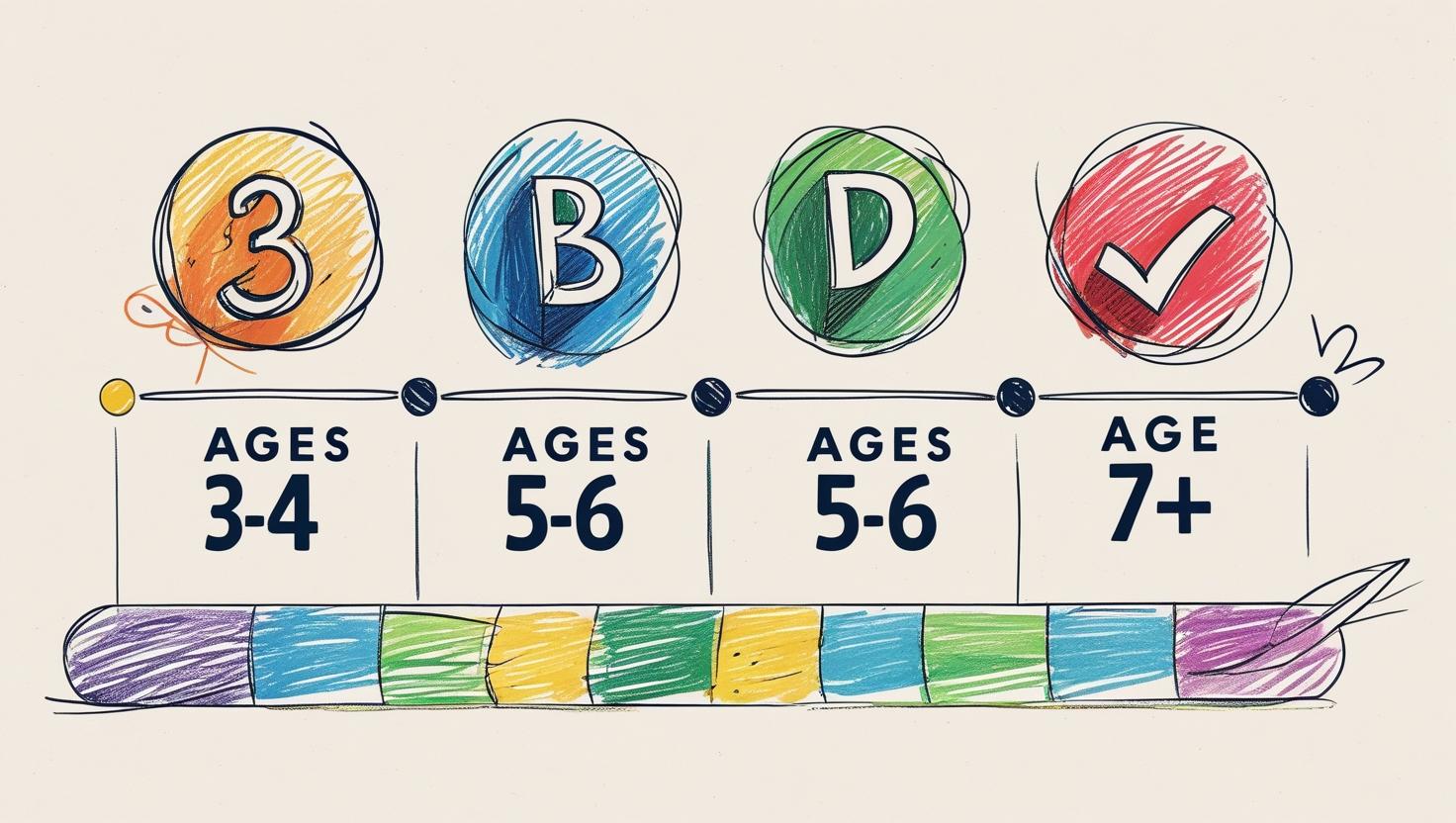
This is the most important section of this guide. Understanding the developmental timeline for letter directionality will help you know when to relax and when to pay closer attention. Here is a clear, age-by-age breakdown based on what we see in preschool and kindergarten classrooms.
Preschool (Ages 3-4)
What you’ll see: Frequent reversals of letters and numbers, writing letters from bottom-to-top or right-to-left, scribbling letters that are barely recognizable.
Expert takeaway: Completely and totally normal. At this stage, a child’s brain is just beginning to understand that letters are distinct symbols. Any attempt to write them, no matter how ‘incorrect’, is a huge win. The goal here is exposure and exploration, not accuracy.
Kindergarten (Ages 5-6)
What you’ll see: This is the peak time for reversing letters ‘b’ and ‘d’, ‘p’ and ‘q’. You’ll also see frequent reversals of numbers like 3, 7, and 9, and letters like S and Z. Sometimes, a child might even write their entire name in mirror image.
Expert takeaway: Still very common and not a red flag. During kindergarten, formal instruction on letter formation begins.
As they practice, you will see a gradual decrease in reversals throughout the year. However, it is still developmentally appropriate for these mistakes to happen regularly. Consistency, not immediate perfection, is the key.
First Grade (Ages 6-7)
What you’ll see: This is the critical transition year. By the end of first grade, most children have solidified the correct orientation for most letters. Reversals may still pop up occasionally, especially when a child is tired or writing quickly, but they should be the exception, not the rule.
Expert takeaway: Pay gentle attention. If reversals are still frequent and consistent by the middle to end of first grade, it’s a good time to have a proactive, collaborative conversation with your child’s teacher. It doesn’t automatically signal a problem, but it does mean it’s time to be a more active observer.
Second Grade and Beyond (Age 7+)
What you’ll see: If a child is still consistently reversing multiple letters and numbers after the age of 7, despite good instruction and practice.
Expert takeaway: This is the point to take more formal action. Consistent reversals after age 7 can be a marker for learning challenges like dyslexia. It is NOT a diagnosis, but it is a clear signal to partner with the school and potentially seek an evaluation from a specialist. The vast majority of children will have outgrown this issue long before this stage.
A Fun, Play-Based Toolkit to Correct Reversing Letters
Once you’ve determined it’s a good time to gently intervene, the key is to use fun, multi-sensory methods. Drills and corrections often increase a child’s anxiety, which can actually make the problem worse. These play-based strategies build the correct neural pathways without the pressure.
For All Letters: Build It, Feel It, See It Big
These techniques work for any letter or number your child is reversing.
- Sensory Writing: Forget the pencil for a while. Have them trace letters in a shallow tray of sand, salt, or shaving cream. The tactile feedback is powerful for muscle memory.
- ‘Sky Writing’: Use the whole arm! Stand up and have your child trace a giant letter ‘S’ or number ‘3’ in the air with their index finger. This builds the motor plan in their brain on a large scale first.
- Play-Doh Letters: Rolling out Play-Doh ‘snakes’ to form letters is a classic for a reason. It strengthens hand muscles while reinforcing the shape and direction of each letter.
Specific Tricks for Common Reversals
For those tricky mirror letters and numbers, a little story or visual cue can be a game-changer.
- The ‘b’ and ‘d’ Bed: This is the most famous trick. Have your child make a thumbs-up with both hands and bring them together. The left hand forms a ‘b’ and the right hand forms a ‘d’, spelling the word ‘bed’. It’s a physical anchor they can always refer to.
- ‘p’ and ‘q’ Parking Garage: Draw a horizontal line. The letter ‘p’ is a car that has ‘pulled in’ to the garage. The letter ‘q’ is a car that is ‘quietly leaving’ the garage and going down the road.
- The ‘S’ Snake and ‘Z’ Zebra: The ‘S’ is a slithery snake. The ‘Z’ is a zippy zebra with zig-zag stripes. Connect the letter to a concrete image.
- For Numbers: For a ‘3’, start at the top and say “around a tree, around a tree.” For a ‘7’, say “across the sky and down from heaven.” These little rhymes build the motor sequence.
Make Writing Meaningful and Fun
Finally, give them a reason to write that feels personal and fun, not like a test. Using fun, low-pressure ‘About Me’ activities is a great way to encourage them to practice letters and words in a context that is all about them.
And for the most important word they’ll ever write, consistent practice with tools like our free Name Tracing worksheets can build confidence and muscle memory for the letters they will use most often.
Partnering with the School: When and How to Ask for Help
You’ve tried the fun activities at home, you’ve been patient, but your child is now past the age of 7 and the reversing letters are still a frequent and consistent issue. This is the moment to shift from a ‘wait and see’ approach to a proactive partnership with your child’s school. Here’s how to do it effectively, without raising unnecessary alarms.
Step 1: Gather Your Observations
Before you talk to the teacher, be a detective. For a week or two, collect specific examples. Don’t just say, “He reverses letters.” Instead, note: “I’ve noticed he consistently reverses ‘b’ and ‘d’ in his homework, and also writes the number ‘5’ backward. It happens about half the time.” Specific data makes the conversation much more productive.
Step 2: Schedule a Meeting (Don’t Ambush at Pickup)
Email the teacher and ask for a brief, 15-minute meeting or phone call to discuss your child’s progress in writing. Trying to have this important conversation during the chaos of afternoon pickup is unfair to both you and the teacher.
Frame it collaboratively: “I’ve been noticing some patterns in [Child’s Name]’s writing at home and would love to hear what you’re seeing in the classroom so we can be on the same page.”
Step 3: Ask the Right Questions
During the meeting, your goal is to gather information and form a team. Here are the key questions to ask:
- “Are you seeing the same frequency of letter reversals that I’m seeing at home?”
- “How does this compare to the other students in the class?” (This helps gauge the developmental appropriateness).
- “What strategies are you currently using in the classroom to address this?”
- “Is this impacting his/her ability to read or complete other work?”
- “What can we do at home to best support the strategies you’re using at school?”
This approach positions you as a supportive partner, not an accuser. Based on this conversation, the teacher may suggest a watch-and-wait approach with shared strategies, or they might recommend a more formal observation from the school’s reading specialist or psychologist. This is the right and responsible path to take if your concerns persist.
10 F.A.Q. About Letter Reversals Answered
We know that seeing reversed letters can bring up a lot of specific worries. Here are our expert answers to the most common questions we hear from parents.
Is reversing letters a sign of dyslexia?
Not on its own, especially in children under the age of 7. This is the most common fear, but it's important to know that dyslexia is a much broader language-processing challenge, not just a visual one. While consistent letter reversals after age 7 can be one of many markers, they must be paired with other signs like significant trouble with rhyming, sounding out words, or learning new vocabulary. For young children, reversals are almost always just a normal developmental phase.
Are letter reversals more common in left-handed children?
This is a popular myth, but the research doesn't strongly support it. While some left-handed children may have a slightly different mechanical approach to forming letters (pushing the pencil instead of pulling), the root cause of reversals is in the brain's developing visual-spatial processing. This process is the same for all children, regardless of which hand they use. The same multi-sensory strategies work for both lefties and righties.
What if my child gets frustrated when I try to correct them?
This is a critical signal to stop direct correction immediately. Frustration shuts down the learning part of the brain. Instead of saying 'That's wrong', shift to a playful modeling approach. Say, 'Oh, 'b' and 'd' are so tricky! Watch how my hand makes a 'b'.' Then, move away from the pencil and paper entirely and switch to a low-pressure sensory activity like forming the letter in a sand tray or with Play-Doh, where there's no 'mistake'.
My 7-year-old still reverses letters sometimes. What is the very next step I should take?
The very next step is to partner with their teacher. Schedule a brief meeting and share your specific observations ('I've noticed he still reverses 'b' and 'd' in his homework about half the time'). Ask the teacher if they are seeing the same frequency in the classroom and what strategies they are using. This collaborative approach is the most effective way to determine if it's a lingering habit or something that needs more focused attention.
Do special pencil grips help with reversals?
Not directly, but they can be a helpful part of the toolkit. Pencil grips are designed to correct an inefficient pencil *grasp*, not a letter reversal. However, if a child's grasp is weak and writing is tiring, they will have less mental energy to focus on things like letter direction. By making the physical act of writing more comfortable, a proper grip can free up brainpower to concentrate on forming letters correctly.
What about reversing whole words, like writing 'was' for 'saw'?
This is very common and comes from the exact same root cause: the brain's still-developing directional awareness. The child is correctly identifying the letters but is processing the entire word as a single 'object' and hasn't yet mastered the left-to-right sequence. This, too, typically resolves on its own with more reading and writing practice.
How is this different from 'mirror writing'?
'Mirror writing' is when a child writes entire words or even sentences backward, as if seen in a mirror. While it looks more dramatic, it's also a phenomenon seen in normally developing young children and is related to the same directional confusion. Like simple letter reversals, it usually fades as their visual-spatial skills mature. If it persists past age 7, it's another data point to discuss with their teacher.
What is the single best (and most fun) activity I can do at home to help?
Without a doubt, large-scale 'Sky Writing'. Have your child stand up and use their whole arm to draw a giant letter in the air. This uses gross motor skills to build a strong 'motor map' of the letter's shape and direction in their brain before they try to shrink it down to their fingers. It's fun, requires no materials, and is incredibly effective.
Patience, Practice, and Progress: A Final Word on Reversing Letters
Seeing your child reverse their letters can be unsettling, but as we’ve explored, it’s rarely a red flag. More often than not, it’s a fascinating window into your child’s developing brain as it learns to navigate the complex world of written symbols. The journey from a mirrored ‘d’ to a confident ‘b’ is a marathon, not a sprint.
Your role in this process is not to be a drill sergeant, but a patient and playful guide. Celebrate the effort, not the perfection. Trust the developmental timeline, and remember that the fun, multi-sensory activities you do at home are the most powerful tools for building lasting skills.
By fostering a positive and low-pressure environment, you are not just correcting a few backward letters; you are nurturing a resilient learner who has the confidence to try, make mistakes, and try again.
For parents who want to provide consistent, fun, and structured practice for every letter of the alphabet, our team has designed a comprehensive solution. Our complete Alphabet Worksheet Bundle is filled with multi-sensory activities that systematically address letter formation and recognition, turning the challenge of reversing letters into a game of mastery.